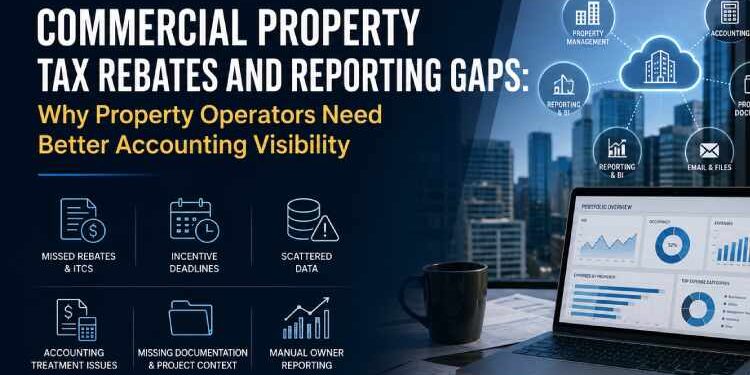
Do you ever miss rebates, ITCs, incentive deadlines, or accounting treatment issues because expenses, projects, invoices, and property context are spread across different systems?
That question is becoming more important for commercial property operators, property managers, asset managers, and real estate ownership groups.
Commercial Property Tax Rebates and Reporting Gaps: Why Property Operators Need Better Accounting Visibility is not really an article about chasing rebates. It is about a bigger issue. Many property operators do not have a reliable reporting layer between property operations, accounting records, project activity, invoices, and ownership decisions.
When that reporting layer is missing, money can be missed, risks can stay hidden, and owner reporting can become a manual process held together by spreadsheets and staff memory.
This article is not tax advice. Property owners should always rely on qualified accountants, tax advisors, and legal professionals for tax treatment and rebate eligibility. The point is simpler: if your property data is fragmented, your advisors may not have the full context needed to identify opportunities, confirm treatment, or support claims with proper documentation.
Table of Contents
- Why property operators miss tax and rebate opportunities
- The issue is usually not carelessness
- Where the data gets scattered
- Why accounting software alone may not solve the problem
- Why Power BI alone may not solve the problem
- The role of portfolio level reporting
- Document readiness and evidence tracking
- Owner reporting and trust in the numbers
- What a better reporting layer should show
- How BP LTD helps property operators improve accounting visibility
- Related Articles
Why Property Operators Miss Tax and Rebate Opportunities
Commercial property operations create a lot of financial and operational activity. A single property may have repairs, maintenance, capital improvements, tenant improvements, energy upgrades, utility costs, vendor invoices, insurance records, lease changes, owner distributions, property tax notices, and financing requirements.
Across a portfolio, this complexity grows quickly. The issue becomes more serious when a company manages multiple buildings, multiple ownership entities, or multiple software systems. A property operator may have some data in Buildium, AppFolio, Yardi, QuickBooks, Sage, Excel, Power BI, email folders, project files, and staff notes.
This creates a reporting gap. The accounting system may show that an expense occurred. The property management system may show which building it relates to. The invoice may explain the vendor and service. The project record may show whether it was part of a larger capital improvement. The property manager may know whether the work affected a commercial unit, residential unit, common area, or mixed use building.
If those facts are not connected, the organization may miss important context. That context can matter for GST/HST input tax credit review in Canada, energy incentive review, capital versus operating treatment, documentation readiness, recoverable expense review, property tax assessment questions, and internal owner reporting.
The missed opportunity is not always a dramatic rebate. Sometimes the missed opportunity is simply finding out that the organization cannot clearly explain its own numbers.
The Issue Is Usually Not Carelessness
It is easy to assume that missed rebates, ITCs, tax credits, or accounting treatment issues happen because someone was careless. In many cases, that is not fair. The more common problem is fragmentation.
Property operators often rely on systems that were designed to manage transactions, tenants, leases, maintenance, or accounting. Those systems are important, but they do not always produce the portfolio level intelligence that ownership, finance, and operations need.
For example, a bookkeeper may code an invoice correctly based on the information available. But they may not know that the expense was part of a larger capital project. A property manager may understand the operational context but may not know how the cost should be reviewed for accounting purposes. An owner may ask for a report, but the data needed to answer the question may sit across three systems and several staff members.
That is how money gets missed. Not because the team is lazy. Because the information required to see the issue is not organized in one place.
Where the Data Gets Scattered
Property reporting problems often begin with normal business growth. A company starts with one system and a manageable number of properties. Reporting may be simple enough at first. As the portfolio grows, the company adds new properties, new owners, new accountants, new staff, new entities, and new reporting expectations. Then complexity arrives.
Common sources of scattered property data include:
- Property management software such as Buildium, AppFolio, Yardi, MRI, Rent Manager, or RealPage.
- Accounting software such as QuickBooks, Sage, Xero, NetSuite, or Microsoft Dynamics.
- Spreadsheets used for owner reporting, budget tracking, tax support, or lender packages.
- Power BI dashboards that may show useful visuals but depend on the quality of the underlying data model.
- Email threads containing approvals, invoice explanations, owner instructions, and vendor records.
- Project folders containing quotes, permits, photos, closeout records, and warranties.
- Staff memory about what happened, why a cost was incurred, and whether something should be reviewed.
This fragmentation becomes painful when leadership asks basic questions such as:
- Which properties are underperforming?
- Which expenses are unusual?
- Which owner reports are still manual?
- Which invoices are missing support?
- Which projects may have rebate, ITC, or incentive relevance?
- Which properties have the highest maintenance burden?
- Which numbers can we trust?
These are not exotic questions. They are normal management questions. But many property operators struggle to answer them quickly.
Why Accounting Software Alone May Not Solve the Problem
Accounting software is essential, but accounting software is not always enough to create property intelligence. An accounting platform may know the general ledger account, vendor, invoice amount, tax code, and payment status. That information matters. But commercial property decisions often require more context.
For example:
- Was the expense related to a commercial property, residential property, or mixed use property?
- Was it tied to a specific unit, building system, common area, or capital project?
- Was the expense part of a maintenance issue, tenant improvement, energy upgrade, insurance claim, or compliance requirement?
- Is the invoice supported by the right documentation?
- Does the owner report explain the expense clearly?
- Does the accountant have enough information to review the treatment properly?
- Does the operator have enough evidence if the transaction is questioned later?
Accounting software can record transactions. It may not fully understand the property, asset, project, and operational story behind those transactions.
That is where reporting gaps appear.
Why Power BI Alone May Not Solve the Problem
Power BI can be a strong reporting tool. It can help property operators visualize trends, compare properties, summarize accounting information, and provide leadership with better dashboards.
But Power BI is not a magic fix for messy property data. If the data model is weak, the dashboard will be weak. If the chart of accounts is inconsistent, the reports may be confusing. If properties are not mapped correctly, portfolio rollups may be unreliable. If data refreshes fail or depend on manual exports, the dashboard may become stale. If the source systems disagree, Power BI may only make the disagreement easier to see.
This is why many reporting projects fail. The company thinks it needs a dashboard. What it really needs is a better reporting architecture.
A useful Power BI environment often depends on work that happens before the dashboard is built:
- Data source review
- Property and entity mapping
- Chart of accounts alignment
- Owner reporting requirements
- Accounting logic
- Data refresh design
- Validation rules
- Documentation standards
- Clear definitions of KPIs
Without those foundations, Power BI can become another layer of confusion.
The Role of Portfolio Level Reporting
The highest value opportunity is usually not one rebate or one tax issue. The bigger opportunity is portfolio level reporting. Portfolio level reporting helps ownership and leadership see across properties, entities, systems, and operating teams.
A strong portfolio reporting layer can help answer questions such as:
- Which properties are generating the strongest NOI?
- Which properties have rising maintenance costs?
- Which owners require the most manual reporting?
- Which expenses need review?
- Which properties have missing documentation?
- Which assets have deferred maintenance or compliance exposure?
- Which systems are producing inconsistent data?
- Which reports are still built manually?
- Which projects may need accountant, tax advisor, or rebate specialist review?
For growth oriented property operators, this is especially important. Companies that acquire properties, manage for multiple owners, or inherit different software systems often reach a point where normal reporting no longer works.
That is when the business starts to feel the pain:
- Our reporting is manual.
- Our accounting is messy.
- Our owner reports take too long.
- Our Power BI dashboard is not trusted.
- Our systems do not agree.
- We cannot see the whole portfolio clearly.
That is the real problem. Tax rebates and incentive opportunities are one symptom. Broken portfolio visibility is the disease.
Document Readiness and Evidence Tracking
Many accounting and rebate issues are not just about whether an opportunity exists. They are also about whether the organization can support the review.
Documentation matters. A property operator may need invoices, proof of payment, vendor information, permits, project records, photos, approvals, warranty details, utility records, lease information, and notes explaining why the work was done.
If those records are scattered across email, accounting software, folders, and staff memory, the organization may struggle to respond quickly.
- This matters for tax review.
- It matters for owner reporting.
- It matters for audits.
- It matters for insurance claims.
- It matters for financing.
- It matters for property sales.
- It matters when a key employee leaves and takes undocumented knowledge with them.
A better reporting layer should not only show financial numbers. It should also show whether the evidence behind those numbers is ready.
For example, a property operator should be able to see:
- Which large expenses are missing invoices?
- Which capital projects are missing closeout records?
- Which vendor files are incomplete?
- Which energy upgrade projects may need rebate documentation?
- Which owner reports include unexplained variances?
- Which accounting review items are still unresolved?
This is not glamorous work, but it protects the business.
Owner Reporting and Trust in the Numbers
Owner reporting is one of the clearest signs of whether a property operation has control over its data.
If owner reports require manual exports, spreadsheet cleanup, copy and paste work, and custom explanations every month, the company likely has a reporting architecture problem.
- Manual owner reporting creates several risks.
- Reports may be delayed.
- Different staff may calculate numbers differently.
- Important explanations may be missed.
- Large expenses may not be properly linked to projects.
- Owners may lose confidence.
- Managers may spend too much time producing reports instead of managing assets.
- Leadership may struggle to compare performance across the portfolio.
The issue becomes worse when a company manages multiple ownership groups or acquired portfolios. One owner may need one report format. Another may need a different set of KPIs. One property may be in Buildium. Another may be in AppFolio. Another may be tracked partly in Excel.
At that point, the company does not only need better reports. It needs a more reliable reporting layer between operations and decisions.
Commercial Property Tax Rebates and Reporting Gaps: Why Property Operators Need Better Accounting Visibility is really about this trust problem.
If ownership cannot trust the reporting process, then every important decision becomes harder.
What a Better Reporting Layer Should Show
A better reporting layer should not replace accountants, bookkeepers, property managers, or tax advisors. It should help them work from cleaner information.
For commercial property operators, a useful reporting layer should support several views.
Portfolio Executive Summary
This view should show occupancy, vacancy, income, expenses, NOI, maintenance trends, arrears, cash flow, and portfolio risk indicators.
Accounting Visibility Report
This view should show unusual expenses, missing support, uncategorized transactions, large variances, manual adjustments, and items requiring review.
Owner Reporting Package
This view should support owner statements, distributions, property performance, expense explanations, budget versus actual, and monthly variance notes.
Multi System Consolidation Report
This view should help operators compare and consolidate data across Buildium, AppFolio, Yardi, QuickBooks, Excel, Power BI, and other sources.
Maintenance and Vendor Intelligence
This view should show work order volume, vendor spend, response times, repeat issues, emergency maintenance, and properties with rising maintenance burden.
Capital Project and Improvement Report
This view should track capital projects, budgets, invoices, approvals, photos, permits, warranties, and completion status.
Document and Evidence Readiness Report
This view should show missing invoices, missing permits, missing vendor documents, missing approvals, missing project records, and incomplete support packages.
Tax, Rebate, and Incentive Opportunity Review
This view should flag potential review candidates for accountants, tax advisors, or rebate specialists. It should not claim eligibility. It should identify items that may deserve professional review.
Examples may include energy upgrades, HVAC work, lighting improvements, EV charging infrastructure, mixed use property expenses, capital improvements, and large commercial property expenses with missing context.
The goal is not to replace professional judgment. The goal is to make sure professional judgment is applied to the right information.
How BP LTD Helps Property Operators Improve Accounting Visibility
BP LTD helps real estate and property operators improve reporting visibility across property management systems, accounting platforms, project records, owner reporting, and portfolio decision making.
Many operators do not need another disconnected dashboard. They need a clearer reporting structure that connects operational activity to accounting visibility and ownership decisions.
That can include reviewing current reporting workflows, identifying manual reporting dependencies, mapping property and entity structures, assessing Power BI or spreadsheet reporting gaps, and helping design a better path toward trusted portfolio reporting. For some operators, the first step may be a focused diagnostic.
A diagnostic can help answer:
- What systems are being used today?
- Where is reporting still manual?
- Which reports are not trusted?
- Where does accounting data lack property or project context?
- Which owner reports take the most time?
- Which data sources need to be connected?
- Which dashboards or reports should be prioritized?
- Which documentation gaps create operational, accounting, or compliance risk?
From there, operators can decide whether they need a Power BI reporting improvement, a property management software integration, an accounting visibility report, a portfolio intelligence layer, or a more complete data architecture.
The key is to stop treating reporting as an afterthought. Commercial property operators need accurate accounting, but they also need context. They need to know what happened, where it happened, why it happened, which property it belongs to, which documents support it, and who needs to review it.
That is how better reporting helps reduce missed opportunities, avoid preventable confusion, and support stronger owner level decision making.
Related Articles
Why Power BI Dashboards Fail in Property Management and How to Fix the Data Architecture
How Real Estate Developers Build Portfolio Reporting Systems from Property Management Software
Buildium to Power BI Reporting: Why Property Operators Need a Better Data Layer