ACC vs CAC vs DCC charges in BC can materially affect whether a development project is financially viable. For property owners, developers, investors, and real estate asset managers, these charges are not just municipal paperwork. They can influence land value, rezoning strategy, financing assumptions, project timelines, and the final return on a property.
The confusing part is that these charges often appear at different stages of the development process. Some are tied to growth-related infrastructure. Some are tied to amenities. Some are negotiated through rezoning. Some may be set by bylaw. In practice, this means a property can look attractive at first glance but become much less attractive once municipal charges, infrastructure upgrades, amenity expectations, and approval conditions are properly understood.
This article explains the difference between Amenity Cost Charges, Community Amenity Contributions, and Development Cost Charges in British Columbia, and why these costs should be reviewed early in any rezoning, development approval, or land acquisition process.
Table of Contents
- What are ACC, CAC, and DCC charges?
- What is a Development Cost Charge?
- What is a Community Amenity Contribution?
- What is an Amenity Cost Charge?
- ACC vs CAC vs DCC comparison
- Why these charges matter before buying or rezoning land
- How municipal charges affect project feasibility
- Why tracking obligations matters across the asset lifecycle
- How BP LTD helps property owners and developers
- Related Articles
What are ACC, CAC, and DCC charges?
ACC, CAC, and DCC charges are different tools used by local governments to help pay for infrastructure, amenities, and community impacts related to growth and development.
In simple terms:
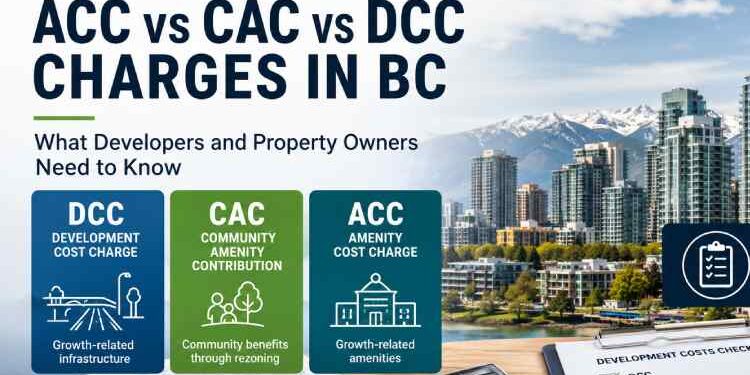
- DCCs, or Development Cost Charges, usually help pay for growth-related infrastructure such as roads, water, sewer, drainage, and parks.
- CACs, or Community Amenity Contributions, are usually negotiated through rezoning and may be provided as cash or in-kind contributions toward public benefits.
- ACCs, or Amenity Cost Charges, are a newer development finance tool in BC that allows local governments to collect funds from new development for certain growth-related amenities.
The details vary by municipality, and this is where risk enters the picture. A project in Nanaimo, Victoria, Vancouver, Langford, Kelowna, or another BC municipality may face different rates, different bylaws, different policy expectations, and different approval conditions.
That is why these charges should be reviewed before assuming a site is a good development opportunity. A competent development management consultant can help you to navigate these issues throughout the life cycle of your real estate project.
What is a Development Cost Charge?
A Development Cost Charge is a fee collected by a local government to help pay for infrastructure required because of growth. These charges are usually established by bylaw and applied to new development.
DCCs commonly help fund infrastructure categories such as:
- Roads
- Water systems
- Sanitary sewer systems
- Drainage systems
- Parks
- Other growth-related infrastructure, depending on the municipality
For a developer, DCCs are often easier to model than negotiated contributions because they are generally published in municipal bylaws or rate schedules. However, “easier to model” does not mean “minor.” DCCs can still materially affect a project’s economics.
A project that appears viable before DCCs may become marginal after all municipal charges, servicing obligations, financing costs, professional fees, and construction costs are included.
This matters for property owners too. If a parcel is being marketed as having redevelopment potential, the buyer should not only ask what can be built. The buyer should also ask what charges, upgrades, conditions, and approvals may be required before that development potential can be realized.
What is a Community Amenity Contribution?
A Community Amenity Contribution is commonly associated with rezoning. CACs are often provided by developers when a municipality grants additional development rights through rezoning.
A CAC may be provided as cash, land, public space, affordable housing, childcare space, cultural space, public realm improvements, or other community benefits. The exact form depends on the municipality, the project, the rezoning proposal, and local policy.
This is where CACs can become complicated. Unlike a simple posted fee, a CAC may involve negotiation, policy interpretation, land lift analysis, community expectations, and political considerations. In some cases, a rezoning application can create an expectation that the developer will contribute toward community amenities because the rezoning increases the value or intensity of use of the land.
For example, if a property is rezoned from a lower-density use to a higher-density use, the municipality may expect some portion of the increased land value or community impact to be addressed through public benefits.
For developers, the risk is uncertainty. If the CAC expectation is not clear early, the project’s economics may shift later in the process. That can affect the purchase price a buyer should pay for land, the amount of density required to make the project viable, and the strategy used when approaching council, staff, lenders, partners, and the public.
What is an Amenity Cost Charge?
An Amenity Cost Charge is a newer development finance tool in British Columbia. ACCs allow local governments to collect funds from new development to help pay for amenities needed because of population and employment growth.
Amenities may include things like:
- Community centres
- Recreation centres
- Daycares
- Libraries
- Other eligible public amenities
The important distinction is that ACCs are intended to provide a more structured way for municipalities to fund growth-related amenities. In some municipalities, ACCs may reduce reliance on negotiated CACs or density bonus systems. In others, ACCs may exist alongside other development finance tools.
For developers and property owners, this creates a transition issue. A municipality may be updating its development finance framework, revising its DCC rates, introducing ACCs, changing CAC policy, or reviewing how charges are collected.
That means a land acquisition or rezoning strategy should not rely only on old assumptions. A property that penciled out under one charge structure may look different under a new one.
ACC vs CAC vs DCC comparison
| Charge | Full name | Usually connected to | Typical purpose | Key risk |
|---|---|---|---|---|
| DCC | Development Cost Charge | Subdivision, building permit, development approval, depending on local rules | Growth-related infrastructure | Published rates can still be expensive and may change |
| CAC | Community Amenity Contribution | Rezoning | Public benefits related to additional development rights | Negotiation, uncertainty, and political risk |
| ACC | Amenity Cost Charge | New development that creates increased demand for amenities | Growth-related amenities such as recreation, childcare, libraries, and community facilities | Newer tool with evolving municipal adoption |
The practical difference is this:
- DCCs are generally infrastructure-focused.
- CACs are generally rezoning and community-benefit focused.
- ACCs are generally amenity-focused and may be more standardized than negotiated CACs.
For a developer, all three can affect the same project. A rezoning project may need to account for DCCs, ACCs, CAC expectations, frontage improvements, servicing upgrades, off-site works, public engagement costs, professional fees, design revisions, environmental requirements, and financing costs.
That is why development feasibility should be treated as a layered process, not a single spreadsheet line item.
Why these charges matter before buying or rezoning land
Many property owners and buyers focus on zoning first. That makes sense, but zoning is only one part of the development equation.
A better question is: What is the real cost of turning this site into the intended use?
That question includes:
- Current zoning
- OCP or neighbourhood plan alignment
- Rezoning requirements
- Development permit requirements
- DCCs
- ACCs
- CAC expectations
- Servicing capacity
- Off-site upgrades
- Environmental constraints
- Public hearing risk
- Neighbour opposition
- Professional consultant costs
- Financing assumptions
- Project timeline
A site can look cheap because the market already understands these risks. Long days on market, repeated price reductions, awkward zoning, unclear servicing, and unrealistic density assumptions may all signal that the property is not as simple as the listing suggests.
This is especially important in BC communities where land values, housing targets, municipal infrastructure deficits, and public expectations are all moving at the same time.
Before buying land for redevelopment, a property owner should understand not only what the municipality may allow, but what the municipality may expect in return.
How municipal charges affect project feasibility
Municipal charges can affect development feasibility in several ways.
- First, they affect the residual land value. If the total cost of approvals, charges, servicing, construction, and financing increases, the amount a developer can afford to pay for land may decrease.
- Second, they affect the density requirement. A project may need more units, more floor area, or a different mix of uses to absorb municipal charges and still generate an acceptable return.
- Third, they affect financing risk. Lenders and investors care about cost certainty. If major obligations are unclear, the project may appear riskier.
- Fourth, they affect timing. If municipal charges, amenity expectations, public engagement issues, or servicing requirements are discovered late, the project may face delays, redesigns, or renegotiation.
Fifth, they affect stakeholder communication. A project can become politically difficult if the public believes the developer is receiving major benefits without providing enough community value. On the other hand, a project can also become financially impossible if public benefit expectations are not grounded in project economics.
The strongest development strategies deal with these issues early.
Why tracking obligations matters across the asset lifecycle
The hidden problem with ACCs, CACs, DCCs, and related obligations is not only the charge itself. It is the tracking.
A development project may create obligations that extend across multiple stages:
- Initial feasibility
- Land acquisition
- Rezoning
- Public engagement
- Council approval
- Development permit
- Building permit
- Construction
- Occupancy
- Operations
- Long-term asset reporting
Over time, important commitments can become scattered across emails, council reports, consultant memos, meeting notes, drawings, spreadsheets, permit conditions, legal agreements, and staff memory.
This creates risk. A developer may lose track of what was promised. A property owner may not understand which obligations remain outstanding. A municipality may struggle to verify whether public benefits were delivered. A buyer may acquire a property without fully understanding inherited obligations. A lender or investor may not have a clean view of project risk.
This is where a stronger asset engagement ecosystem becomes useful. Development charges and amenity commitments should not be treated as isolated costs. They should be connected to the project record, stakeholder engagement, approval milestones, public commitments, sustainability goals, occupancy outcomes, and long-term asset performance.
How Beyond Programs LTD helps property owners and developers
Beyond Programs LTD helps property owners, developers, and real estate organizations think through development, asset, technology, marketing, and sustainability challenges in a more connected way.
For projects involving rezoning, land acquisition, public engagement, or development approvals, Beyond Programs LTD can support:
- Early feasibility review
- Rezoning strategy
- Municipal charge and obligation tracking
- Public engagement planning
- Project reporting
- Stakeholder communication
- Asset lifecycle visibility
- Technology and workflow setup
- Marketing and launch planning
Through our Beyond Programs LTD’s TEAMS approach, which includes Technology, Events, Assets, Marketing, and Sustainability, development projects can be reviewed as more than a permit application. They can be treated as real assets with financial, operational, public, and lifecycle considerations.
This is especially important when dealing with ACC vs CAC vs DCC charges in BC, because these costs can influence much more than the approval process. They can affect land value, financing, public trust, project timelines, and the long-term success of the asset.
If you are evaluating land, preparing a rezoning application, reviewing a development opportunity, or trying to understand whether a project still pencils out after municipal charges, Beyond Programs LTD can help you organize the moving pieces before they become expensive surprises.
Related Articles
How Much Does Rezoning Cost in BC? A Complete Breakdown for Developers and Property Owners
Reimagining CACs: What Happens When Art Creates Community Feedback?
How to Rezone Your Property in BC: Step-by-Step Guide for Homeowners and Developers