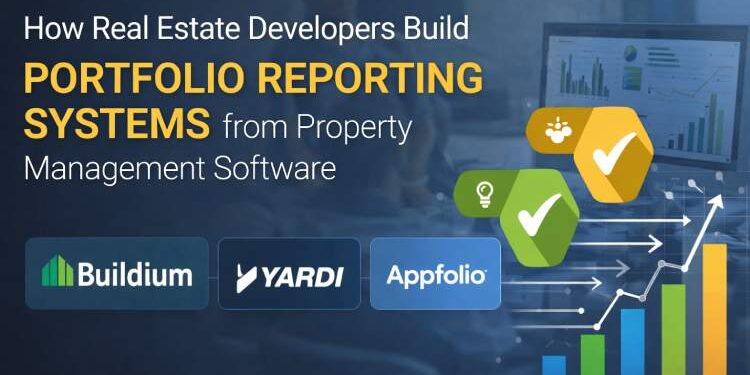
Real estate developers and asset owners increasingly rely on property management software such as Buildium, Yardi, and AppFolio to operate their portfolios. These platforms are excellent for day-to-day property operations like collecting rent, managing leases, and communicating with tenants. However, as portfolios grow and organizations begin to manage multiple buildings or development projects simultaneously, executives often discover a major limitation.
Property management systems are designed for operations, not for portfolio level reporting and executive decision making.
Finance leaders, development executives, and asset managers often need answers to questions that operational software alone cannot easily provide. They want to understand how their assets are performing across the entire portfolio, how leasing trends are evolving, and how operational signals impact long-term financial outcomes.
To solve this gap, many real estate companies build portfolio reporting systems that extract data from property management software and transform it into meaningful insights for leadership teams.
This article explains why developers build these systems, how they typically work, and what architecture real estate companies use to transform operational data into portfolio intelligence.
Table of Contents
- The Reporting Problem Real Estate Developers Face as They Scale
- Why Property Management Software Does Not Solve Executive Reporting
- How Developers Build Portfolio Reporting Systems
- The Typical Architecture Behind Real Estate Reporting Platforms
- Common Problems with Property Management Data Pipelines
- How Finance Teams Turn Operational Data into Portfolio Intelligence
- When Real Estate Organizations Need Outside Expertise
- The Future of Portfolio Reporting for Real Estate Developers
The Reporting Problem Real Estate Developers Face as They Scale
When a developer owns only one or two properties, reporting is relatively simple. Financial information can be reviewed directly in the property management platform, and operational decisions are often based on conversations with property managers.
As portfolios grow, however, the reporting requirements change dramatically.
Executives begin asking broader questions about real estate lifecycle performance across the entire portfolio. Instead of reviewing a single building, leadership wants to understand trends across dozens of assets. They want to compare vacancy rates between regions, track leasing velocity across new developments, and evaluate how operational issues affect financial outcomes.
This is where many organizations encounter a structural limitation. Property management software stores operational data, but it rarely presents that data in a format suitable for executive reporting.
As a result, companies begin exporting information into spreadsheets, building manual dashboards, or hiring consultants to design portfolio reporting systems that consolidate information from multiple sources.
Why Property Management Software Does Not Solve Executive Reporting
Property management platforms such as Buildium, Yardi, and AppFolio are designed primarily to support operational workflows. Their interfaces are optimized for property managers who need to perform tasks such as recording leases, tracking maintenance requests, or managing tenant communication.
While these systems do provide built-in reports, they are generally designed to answer operational questions rather than portfolio level questions.
For example, property management software can easily display current lease information for a specific property. However, it may not easily answer questions such as how lease expirations are distributed across the entire portfolio or how tenant turnover trends have evolved over the past several years.
Finance teams often need to evaluate portfolio performance, not just individual property activity. They want to understand how assets perform relative to business plans, investment targets, and development forecasts.
To answer those questions, companies must extract operational data from property management platforms and combine it with other information such as financial projections, leasing pipelines, development milestones, and investor reporting metrics.
This process requires building a real estate portfolio reporting system.
How Developers Build Portfolio Reporting Systems
Most real estate developers do not attempt to replace their property management software. Instead, they treat it as the source of truth for operational data and build additional reporting infrastructure on top of it.
The first step typically involves extracting data from the property management platform using its API or export functionality. Systems like Buildium provide APIs that allow developers or analysts to retrieve information about leases, tenants, properties, financial transactions, and operational activity.
Once the data is extracted, it is stored in a centralized database where it can be combined with other information such as development forecasts, marketing activity, and investment targets.
This centralized data environment allows analysts and executives to evaluate performance across multiple assets simultaneously. Instead of reviewing reports building by building, leadership teams can analyze portfolio trends, compare regions, and identify operational signals that affect financial performance.
Over time, the reporting environment becomes a key decision support system for the organization.
The Typical Architecture Behind Real Estate Reporting Platforms
Although the specific technologies vary between organizations, most portfolio reporting systems follow a similar architecture.
Operational platforms such as Buildium or Yardi provide the raw data. Data pipelines then extract information from these systems and load it into a centralized database or warehouse. From there, transformation processes organize the data into structures that can support reporting and analysis.
Once the data is properly structured, business intelligence tools such as Power BI or Tableau are used to create dashboards that visualize portfolio performance.
In many organizations, the architecture looks conceptually like this.
Operational systems provide the source data. Data pipelines ingest information into a database environment. Data transformation processes organize the data into reporting models. Business intelligence dashboards present insights to leadership teams.
This architecture allows real estate organizations to convert property management data into portfolio intelligence.
Common Problems with Property Management Data Pipelines
While the architecture described above is common, many organizations encounter problems after their reporting systems are implemented.
One of the most common issues is incomplete data ingestion. APIs often return large datasets in multiple pages, and if pagination is implemented incorrectly, entire segments of data may be missing from the reporting system.
Another frequent problem occurs when pipelines apply incorrect filters or field mappings. For example, properties that are marked as inactive or under development may be excluded from reporting even though they should still appear in portfolio analysis.
Reporting problems also emerge when KPI definitions are not aligned with how the business actually evaluates performance. Dashboards may calculate vacancy rates or leasing metrics differently than finance teams expect, leading executives to lose trust in the data.
These challenges are common because property management systems were not originally designed to feed complex portfolio reporting infrastructures. As a result, many organizations rely on internal analysts or external consultants to stabilize their reporting pipelines and ensure that the data accurately reflects operational reality.
How Finance Teams Turn Operational Data into Portfolio Intelligence
Once reliable data pipelines are established, finance teams can begin transforming operational information into strategic insights.
Lease data becomes the foundation for analyzing occupancy trends and revenue performance. Maintenance records can reveal operational inefficiencies that impact tenant satisfaction. Leasing inquiries and tour data can provide early signals about demand for new developments.
By combining operational data with business plan targets and investment assumptions, executives can evaluate whether assets are performing as expected. They can identify properties that are underperforming, detect operational risks before they impact financial results, and monitor how development projects transition into stabilized assets.
This transformation from raw operational data to portfolio intelligence is the true goal of modern real estate reporting systems.
When Real Estate Organizations Need Outside Expertise
Many real estate companies begin building reporting systems internally. Analysts or consultants often create initial pipelines, dashboards, and data models that support executive reporting.
However, as portfolios grow and reporting requirements become more complex, organizations frequently encounter challenges that require outside expertise.
Common triggers include incomplete data ingestion, broken reporting pipelines, inconsistent KPI definitions, and difficulties integrating operational platforms with reporting environments.
When these problems occur, companies often seek specialists who understand both real estate operations and data infrastructure. Advisors who can bridge the gap between property management systems and executive reporting tools can help organizations stabilize their reporting environments and ensure that leadership teams have reliable visibility into portfolio performance.
The Future of Portfolio Reporting for Real Estate Developers
As real estate portfolios become larger and more complex, the importance of data driven decision making continues to grow. We discuss some of this in our BC 2026 Property Portfolio Lifecycle Risk Forecast post.
Developers are increasingly transitioning from simple operational reports to comprehensive portfolio intelligence platforms that combine operational, financial, and development data. These systems allow organizations to understand not only what is happening within their assets but also why those outcomes occur.
Over time, the organizations that build effective portfolio reporting systems gain a significant advantage. They can detect risks earlier, identify performance opportunities faster, and make better strategic decisions about their assets.
Property management software remains an essential operational tool, but the companies that succeed at scale are the ones that transform that operational data into meaningful portfolio intelligence.